If this message is not displayed properly, click here please. |
|
|
|
3-Day Lecture 2026 - Register Now! |
|
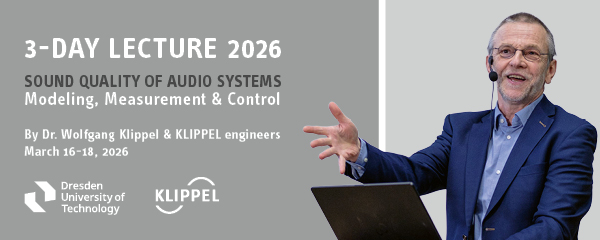
Join us at our popular 3-Day Lecture „Sound Quality of Audio Systems“!
Only 20 days left until the start of the 3-Day Lecture by Prof. Dr. Wolfgang Klippel.
Prof. Wolfgang Klippel will deliver an inspiring series of lectures covering advanced measurement and diagnostic techniques used across telecommunications, the automotive industry and multimedia. You’ll also discover professional applications for designing compact, lightweight and cost-efficient loudspeakers. Our KLIPPEL development engineers will enrich the sessions with hands-on demonstrations that bridge the gap between theory and real-world application.
And since great learning happens when people come together, we’ll wrap up the event with our traditional KLIPPEL House Party and Inhouse Exhibition on March 16th, 2026! The ideal occasion to exchange ideas, meet fellow audio enthusiasts and enjoy a relaxed evening at our HQ in Dresden
Take this opportunity to deepen your expertise, expand your professional network and gain fresh insights into the world of audio engineering!
|
|
Online registration is open until March 9, 2026!
|
|
|
Application Note of the Month |
|
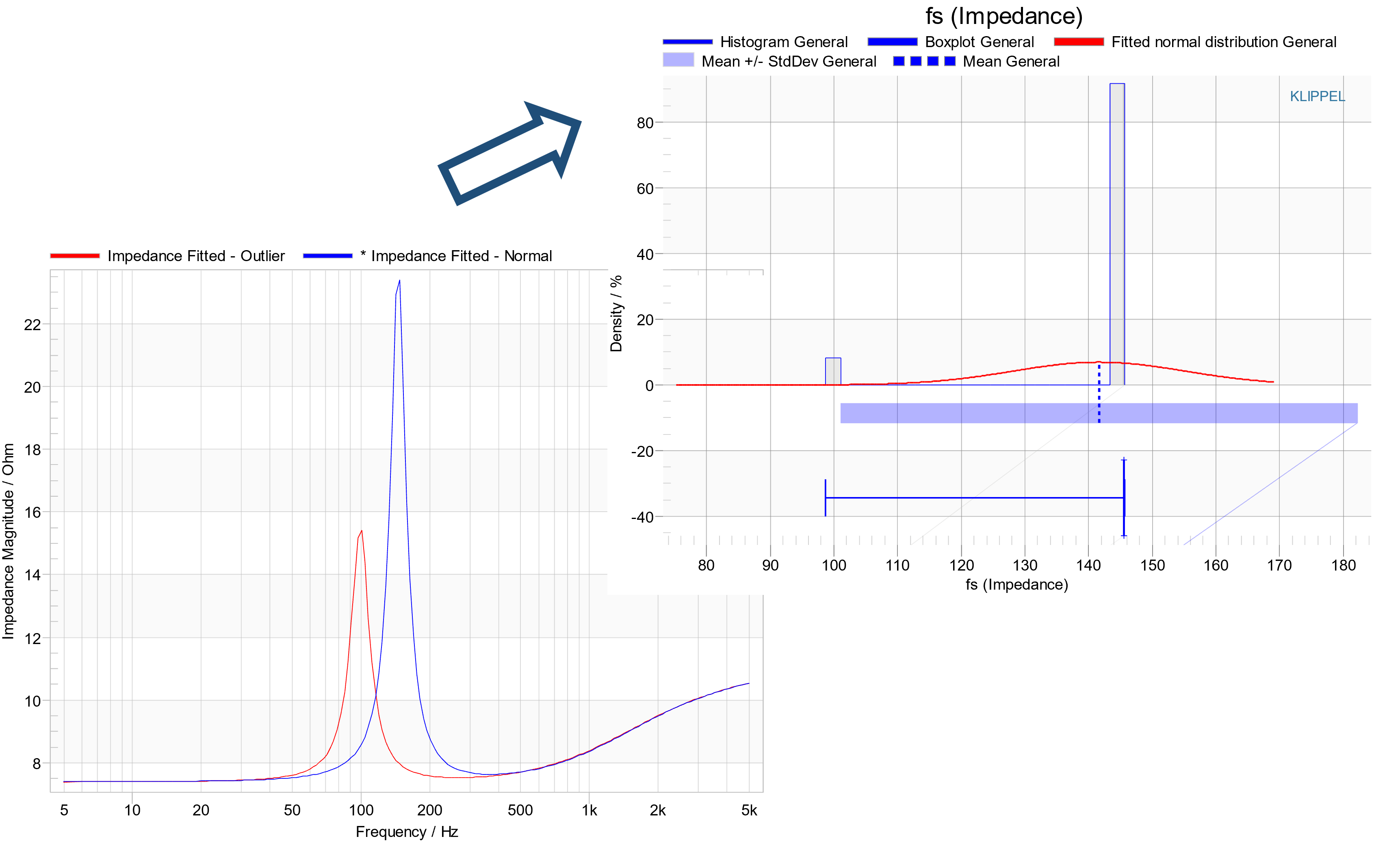
Tolerances of the Resonance Frequency fs
The fundamental resonance frequency fs is a key indicator of loudspeaker performance, closely tied to suspension compliance and moving mass. But how stable is fs across production batches and how can its variation be measured and controlled?
This Application Note 42 presents findings from a systematic and statistical investigation of multiple units from four loudspeaker types. The results reveal that fs is not only affected by intrinsic properties like moving mass (Mms) and compliance (Cms), but also by external and procedural influences such as:
- Ambient conditions (temperature, humidity)
- Excitation signal and speaker orientation
- Measurement history and instrumentation
The application note discusses how the mechanical compliance Cms(t,f) varies with displacement, time, and environmental factors, while Mms can fluctuate due to glue, assembly, or air load. Importantly, only Cms and Mms directly influence perceived sound performance in end-use applications.
Using modern measurement systems with proper setup short stimuli, optimized SNR, and precise signal processing engineers can achieve highly reproducible fs measurements in under 500 ms.
📘 Want to define meaningful tolerances for fs and improve consistency across your product line? » Read the full Application Note 42 and explore best practices for high-speed, reliable measurement.
|
|
Customer Survey - Your Measurement Priorities |
|
Which measurement tasks are most critical in your daily work?
We are currently refining our product roadmap and would like to better understand which measurement tasks are most relevant to your daily work.
The survey takes less than 2-3 minutes and consists of 3 short questions:
- Ranking of measurement task priorities
- Identification of mandatory tasks
- Optional comments for our development team
Your input helps us align future development with real-world engineering requirements.
|
|
Latest Paper Now Available On Our Website! |
|
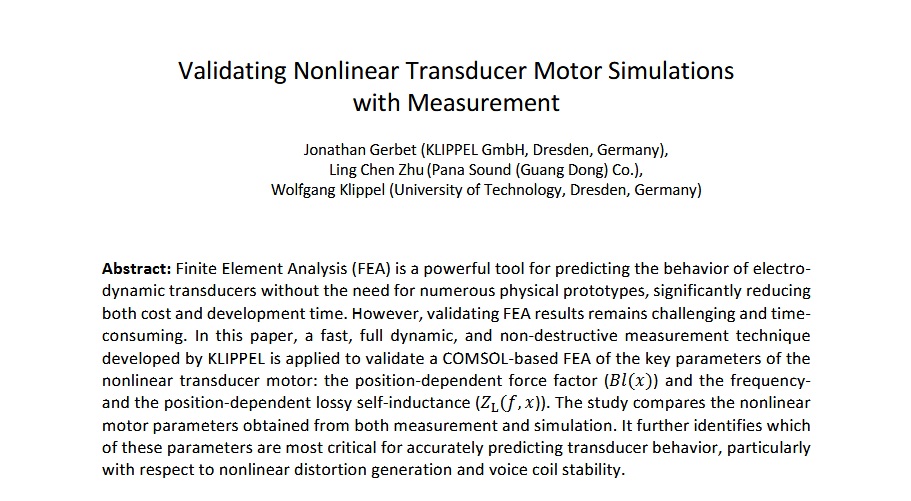
Entitled 'Validating Nonlinear Transducer Motor Simulation with Measurements', the paper was presented by Jonathan Gerbet at last year's ISEAT conference and was very well received by an audience of around 300 participants, sparking many insightful discussions. If you were unable to attend the event in person but are interested in Jonathan's work, we would be happy to share the full paper with you online.
👉 What's the paper about?
Finite element analysis (FEA) is a powerful tool for predicting the behavior of electrodynamic transducers without the need for numerous physical prototypes. However, validating FEA results remains challenging and time-consuming.
In his paper, Jonathan highlights the application of a fast, full dynamic, non-destructive measurement technique developed by Klippel to validate a COMSOL-based FEA simulation of the position-dependent force factor (Bl(x)) and the frequency- and position-dependent lossy self-inductance (Z_L (f,x)). The study compares the nonlinear motor parameters obtained from measurement and simulation and identifies the parameters most critical to accurately predicting transducer behavior, particularly with respect to nonlinear distortion generation and voice coil stability.
|
|
Did you miss our latest newsletter? Click here to read our latest issue. |
|
|
|
KLIPPEL GmbH Mendelssohnallee 30, 01309 Dresden (Germany)
+49-351-5019390 | info@klippel.de | CEO: Benjamin Barth
Register: HRB 15005 Dresden | Tax ID: DE190608924
Copyright © 2026 KLIPPEL GmbH, All rights reserved. |
|
|
|
|
|
If you don't want to receive any more messages (to: unknown@noemail.com), you can unsubscribe here free of charge at any time. |
|
|
|
|